
The Bony Lady goes public
2026-10-07
The Gold Niña of Alfarería Street: Doña Queta's Shrine and Santa Muerte's Coming Out of the Closet
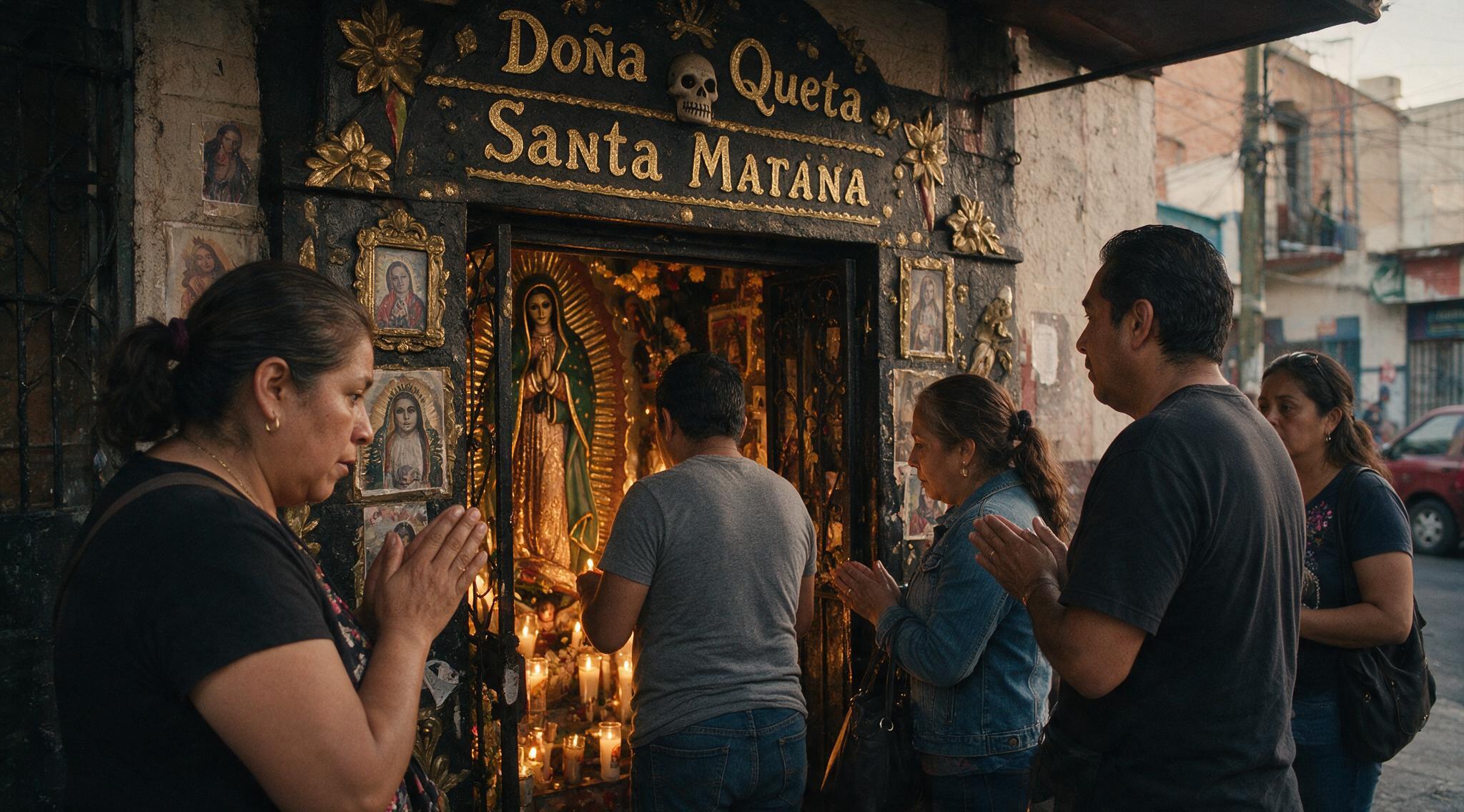
On Halloween of 2001, Enriqueta Romero set a life-size skeleton on the sidewalk outside her home on Alfarería Street in Tepito, Mexico City, and let the neighbors look. Everyone in the barrio calls her Doña Queta. She wasn't starting a church that night. She was putting her saint where she could see her, and the Doña Queta Santa Muerte shrine that came out of it's what researchers call the first public altar of Santa Muerte in Mexico. It still stands on the same street, still drawing people from all over the country to line up at a glass case that holds a skeleton in cloth.
Nobody expected the rest. Before that night, Santa Muerte was venerated quietly indoors, because Catholics and Protestants alike could make life hard for anyone seen with her. R. Andrew Chesnut, who holds the Bishop Walter F. Sullivan Chair in Catholic Studies at Virginia Commonwealth University, wrote in HuffPost that setting the statue out on Halloween of 2001 marked the public outing of a clandestine folk saint, and that the fastest growing new religious movement in the Americas starts there.
Chesnut puts the devotion at 10 to 12 million members, mostly in Mexico, Central America and the US, with others in the four corners of the globe. In 2023, Pablo Sánchez Olmos, writing for El Mundo, reported more than eight million faithful in Mexico alone. Most of them come to a robe, and for money the robe is gold.
What the Doña Queta Santa Muerte Shrine Is: The First Public Altar
It's a house on Alfarería Street with a skeleton out front. The statue is life-size and behind glass, so you can see her and you can't touch her. Doña Queta, born in 1945, has venerated Santa Muerte since she was a girl, long before anyone thought of putting her on a sidewalk. She keeps a shop in Tepito and she keeps the shrine herself, and El Mundo describes the altar she keeps as the oldest and most important in Mexico City.
It works like a public table, not a parish. Devotees bring their own figures to be blessed at the shrine, one woman brought her Lady in Red, according to a HuffPost photograph from the site. Handcrafted statues sit around the glass case. A researcher who first met Doña Queta in the summer of 2009 wrote that she gave him full access to devotees who arrive at all hours of the day and night. Nobody hands you a membership card. You come, you greet her, you leave what you brought, and you go back to work.
What It Is Not: Myths, Mislabels, and Distinctions
Tepito has a reputation as a black market barrio, the place where it's said that everything is for sale except dignity, and that line gets folded into almost every story about the shrine. That fold is where the reporting usually goes wrong. A Foreign Policy profile published in April 2010 found something plainer and stranger: an outdoor mass, some 5,000 worshippers surging toward the glass case, and a great-grandmother in a faded housedress placing a skull pendant around a visiting writer's neck.
Doña Queta has always refused to institutionalize the devotion. That's why there's no rulebook, no roster and no official Santa Muerte. And the shrine sells no outcomes. Any promise of a guaranteed result in her name is coming from somebody else.
Halloween 2001: The Night the Bony Lady Came Out of the Closet

You can measure how unknown Santa Muerte was in 2001 by who hadn't heard of her. Chesnut has written that his in-laws, 86 years old and lifelong residents of Michoacán, only learned about the Bony Lady through his research. A saint with millions of devotees now was, in 2001, invisible in a state where she has shrines today.
The closet had a cost. Devotion stayed indoors because being seen with her could bring rebuke, and in some places worse, from Catholic and Protestant neighbors alike. The sidewalk changed that in one night. The 15th anniversary of the outing drew crowds back to Alfarería Street, and so does the first of every month. The shrine's birthday is Halloween, but its pulse is monthly. National Geographic reported that on the first of each month worshippers crowd the Tepito shrine despite the Roman Catholic clergy's denouncement of the icon. A calendar did the work an institution would have done.
The Gold Aspect: Why the Golden Robe Means Money and Prosperity

Gold is the working color. When you see Santa Muerte in a gold robe, you're seeing the aspect devotees approach about money: the stall fee, the week's stock, the rent, the debt, the job that has to hold until payday. National Geographic lists love, money and protection as reasons to greet La Santa Muerte with a kiss, and money isn't the least of them for a family selling on a street where everything is for sale except dignity. The robe is the request you can see from across a room. A small statue dressed in gold is the same sentence as a gold candle.
Light the gold candle and you're asking about work. Set a couple of coins beside 1 glass of water and you're putting your week on the table, not a fantasy. The devotees who come to the gold Niña aren't asking to get rich by accident. They're asking to stop sinking, and you can hear the difference when someone says it out loud.
Petitioning the Gold Niña in the Barrio Bravo: Offerings, Blessings, and First-of-the-Month Devotion

The shrine sits in what Mexicans call a barrio bravo, and the street shows it. On the Day of the Dead, El Mundo reported whole families, young people and the elderly, brass bands, firecrackers, and a smell of gunpowder, flowers and alcohol. Two rows of street stalls sell offerings and mortuary figures along the approach, and some devotees crawl the last meters on their knees as an expression of maximum respect for a figure the paper credits with more than eight million followers in Mexico.
That's the street practice, loud and crowded, and you don't have to copy anything you see there. Journalists have reported alcohol left among the offerings at the shrine. Gold asks for less: a candle you can watch burn, water in a glass, a few coins, flowers if you have them. Ask for one thing with a number attached, a rent, a stock bill, a shift, and say out loud what you'll do when it comes. Then do that part yourself. This site keeps a page on petitions if you want the shape of one, and one on novenas if you'd rather run a gold prayer for 9 days than one night.
The Godmother Who Refused a Church: Doña Queta and Devotion Without Institution

Other Santa Muerte leaders built temples. Doña Queta kept her house. On the gritty outskirts of Mexico City, Enriqueta Vargas runs the Santa Muerte Internacional Temple that her son Jonathan Legaria Vargas founded, inaugurated on 27 January 2008. He was killed that July, in a hail of 150 bullets fired into his Escalade, and his mother took up the role of Madrina afterward. Doña Queta never took up a title. Researchers who study both shrines note that the Tepito warden always refused any kind of institutionalization, which is why the movement's most famous altar has no organization behind it. In the fall of 2015, the two Enriquetas finally met in Tepito.
She has said why people come. Mexico's Catholic churches stand empty while thousands of Holy Death shrines have spread across the country, she told Foreign Policy, because "the church reprimands," but Santa Muerte never does. "She accepts everyone, with faults and without." That sentence is the shrine's whole policy, and it explains the gold too. Someone who isn't judged for her failures can still ask for next month's rent.
Limits
A candle doesn't replace a doctor or a lawyer, and this house won't pretend otherwise. If you're sick, see a clinician. If you're in legal trouble, get a lawyer, and treat a novena as something that runs alongside that work, not instead of it. Keep the door locked and the fire safe. Never leave a candle burning unattended, keep flame away from cloth, paper and plastic, and set it on something that won't catch. Consent matters here as much as anywhere. Don't petition over another person's body or will. And if a stranger offers you a paid working in her name that promises to ruin someone, walk away. That isn't devotion, and it isn't this shrine. Ethics and safety covers the rest.
There's also a limit on what anyone can tell you. Everything in this article about the shrine comes from journalists and scholars who went there, not from an office that issues statements. The shrine publishes no numbers and no doctrine, and Doña Queta has never run it as an institution. So hold every figure as reported, not official, and trust the sidewalk over the press release.
Questions people actually ask
### Where is Doña Queta's Santa Muerte shrine?
On Alfarería Street in Tepito, in Mexico City. It's the sidewalk altar outside Enriqueta Romero's home, and it's considered the first public Santa Muerte shrine in Mexico, set out on Halloween of 2001. Some devotees still crawl the last meters on their knees.
### When is the busiest day to go?
The first of each month, when worshippers crowd the shrine, and around the Day of the Dead, when families, bands and vendors fill the street. It's a home in a working barrio, not a museum. Go with someone who knows the street.
### What do you bring to the gold Santa Muerte?
A gold candle, 1 glass of fresh water, a few coins, flowers if you have them. Keep it small. The offering is attention and follow-through, not a price tag.
### Does the gold robe mean money only?
Money is the usual reason. National Geographic lists love, money and protection together, so gold also covers a fair job, a legal fight and a business that stays honest. Same robe, same door.
### Was Doña Queta the founder of Santa Muerte devotion?
No. She has venerated Santa Muerte since she was a girl, and the devotion is older than she is. What she started, without meaning to, was its public life. In October 2001, by the account of the researchers who study the shrine, the first public altar appeared in Tepito, and nothing about the devotion has been private since.
Start small tonight. Fill a glass with water, set it where you work, and put a gold candle beside it if you have one. Before you light it, say the number out loud. Then keep whatever you promised in exchange, because that's the part the gold Niña is actually listening for. If you want the colors laid out side by side before you choose one, the aspects page is your next stop, and who is Santa Muerte is where the story behind the sidewalk begins.