
Tepito, Mexico City
2026-10-09
The Black Aspect of Santa Muerte in Tepito: Public Devotion, Stigma, and Protection
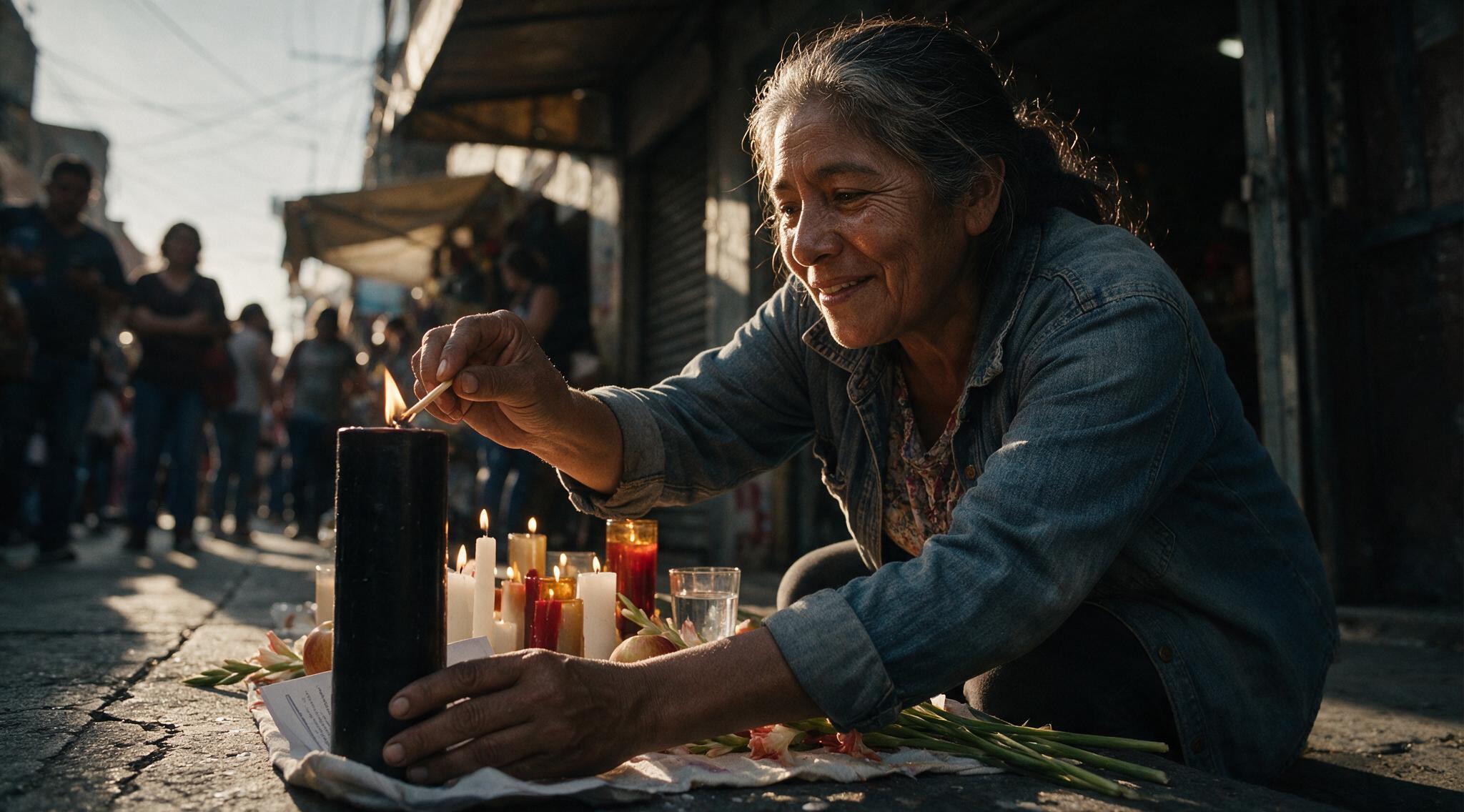
On the first day of each month, thousands of devotees walk down Alfarería street in Tepito, and the portable altars go up hours before the rosary begins. The sidewalk fills. The air carries marijuana, tobacco, and glue, huffed by some of the teens. You'll see her in white, in gold, in red. You'll see her in black.
From that sidewalk, the black aspect is the robe that gathers the hardest petitions, and it's the one outsiders get wrong most. People light a black candle to ask for cover. They don't light it to curse anybody. This piece is about that robe, that candle, and what people in a barrio marked by informal commerce and thin state protection actually bring to her.
What This Is
The black aspect is Santa Muerte in a black robe, and in practice that means a black candle, a black-clad statue, or a black cloth on a small table. That's the object level. On the devotional level, black belongs to the protection cluster: protection against witchcraft, against assaults, against gun violence, and against violent death, alongside safe passage and healing among the attributes devotees ask her for.
Here's the honest part. The sources don't hand you a fixed dictionary where black equals one thing. Her robe can be of any color or pattern, and specific images vary widely from devotee to devotee. The black aspect isn't a locked symbol anyone can decode. Devotees pick the robe based on what they're carrying that month.
In Tepito the choice happens in public. The monthly rosary at the Alfarería street shrine, founded by the cult pioneer Enriqueta Romero on Halloween, 2001, is the signature public ritual of this devotion. The prayer goes up to both the Virgin Mary and Saint Death. Roush dates the monthly prayer service to September 2001. Either way, it's been running for more than two decades now, and it turned a household image into a street institution.
What This Is Not
The black aspect isn't a narco-saint brand, and it's not a how-to for harm. You won't find curses here, or lover-binding, or a line of text promising she'll ruin someone who crosses you. I skip those because they don't match the sources, not because I'm squeamish. Laura Roush, writing about a single altar in Tepito, found that the monthly service balances the needs of its congregation with a kind of response to accusations against devotees in the mass media, and that the iconography gets used for laments and high-minded indignation over the blanket attribution of violent intentions to a population. It also gets used as a language for making threats.
Both things are true at once. The average devotee is always affected by the likelihood that new acts of violence will be styled as religious. That's the pressure they live under, and it's not the same as the act itself. So when you see a black-robed statue in a photograph with a caption about cartels, hold the caption loosely. Roman Catholic clergy have denounced the icon outright, and denunciation travels faster than ethnography.
Black isn't a rank, either. She isn't a Vatican saint with a color hierarchy, and no authority hands out black robes. The color comes from the devotee, the vendor, the workshop, the family that's been keeping the same statue for years.
How Public Santa Muerte Devotion Rose in Tepito
Tepito is a Mexico City barrio historically specialized in informal and illegal commerce, and that history is the ground the devotion grew in. It grew out of the marketplace, not the cartel. In a neighborhood where the state's protection has been thin and its policing has been thick, a saint who watches over the unprotected makes obvious sense.
On Halloween, 2001, Enriqueta Romero put the image at the center of what became the most famous Santa Muerte shrine in Mexico, on Alfarería street. The first-of-the-month rosary followed. Thousands of devotees now converge there each month, many arriving hours in advance of the late afternoon service to claim a few feet of sidewalk for their portable altars. Vendors work the crowd. Statues in every color line the tables.
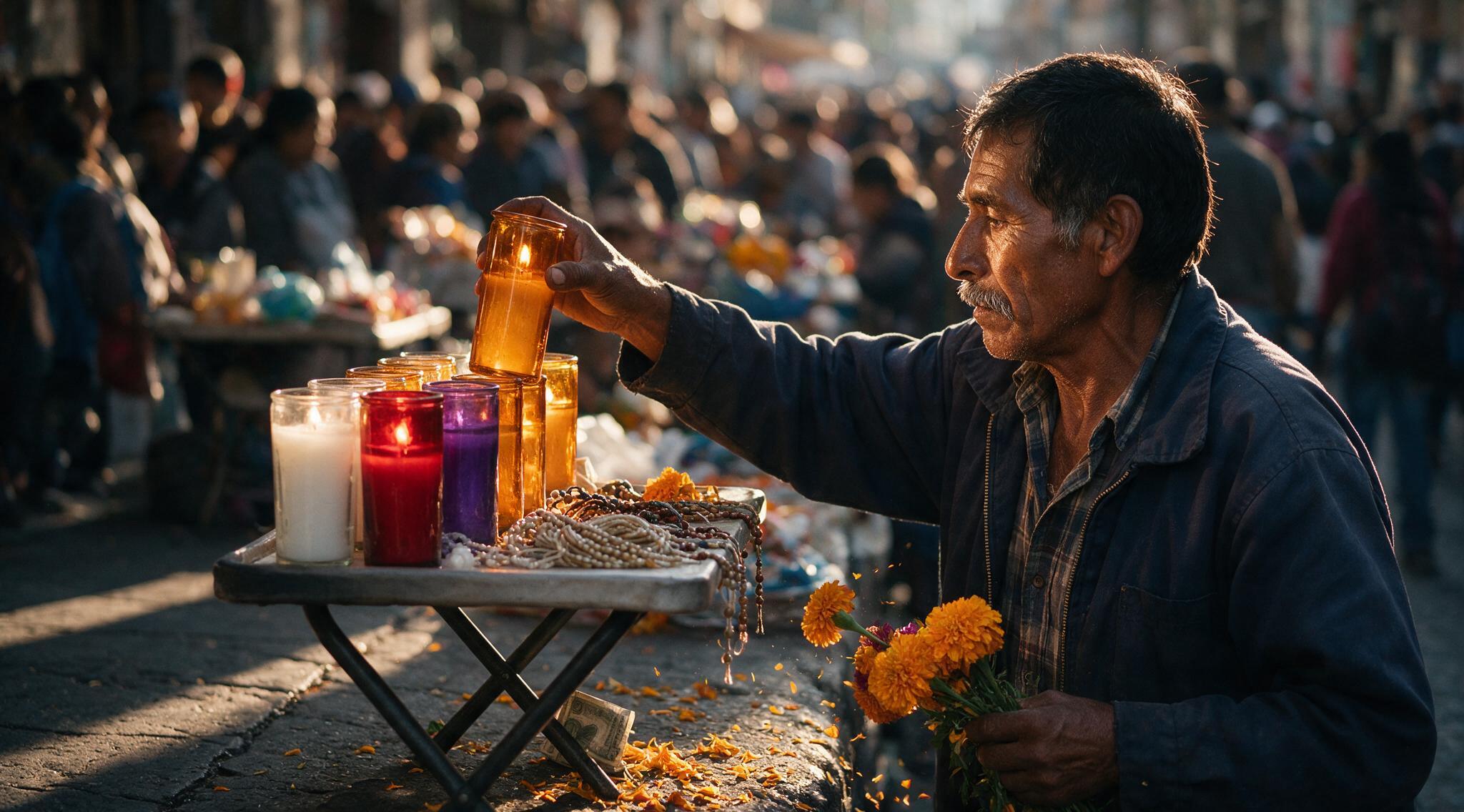
On August 1, 2014, the religious studies scholar Andrew Chesnut and the photographer Toni François spent the afternoon at that shrine. Chesnut, who wrote *Devoted to Death: Santa Muerte, the Skeleton Saint*, described the diversity of images of the Bony Lady as astounding, proof of the creativity and dedication of devotees. A tourist who only knows the black robe never sees that. The variety is the point.
The Black Aspect: Color, Protection, and Religious Bricolage
Santa Muerte isn't a single-tradition saint. Kate Kingsbury and Andrew Chesnut trace her to a colonial-era syncretic pairing of the Spanish Catholic Grim Reapress with Pre-Columbian Indigenous thanatologies, and then describe how the movement kept integrating: Afro-Cuban Santeria and Palo Mayombe, New Age beliefs and practices, even Wicca. Their article ran in *Religions* 12:220, published March 21, 2021.
That's religious bricolage, and it explains why color works the way it does here. Devotees borrow, combine, and re-purpose. A black robe can hold a family's grief over a son in prison, a shopkeeper's fear of a robbery, a nurse's request for a safe night shift. None of those needs a codebook. They need a table, a candle, and a color the person can look at and mean something by.
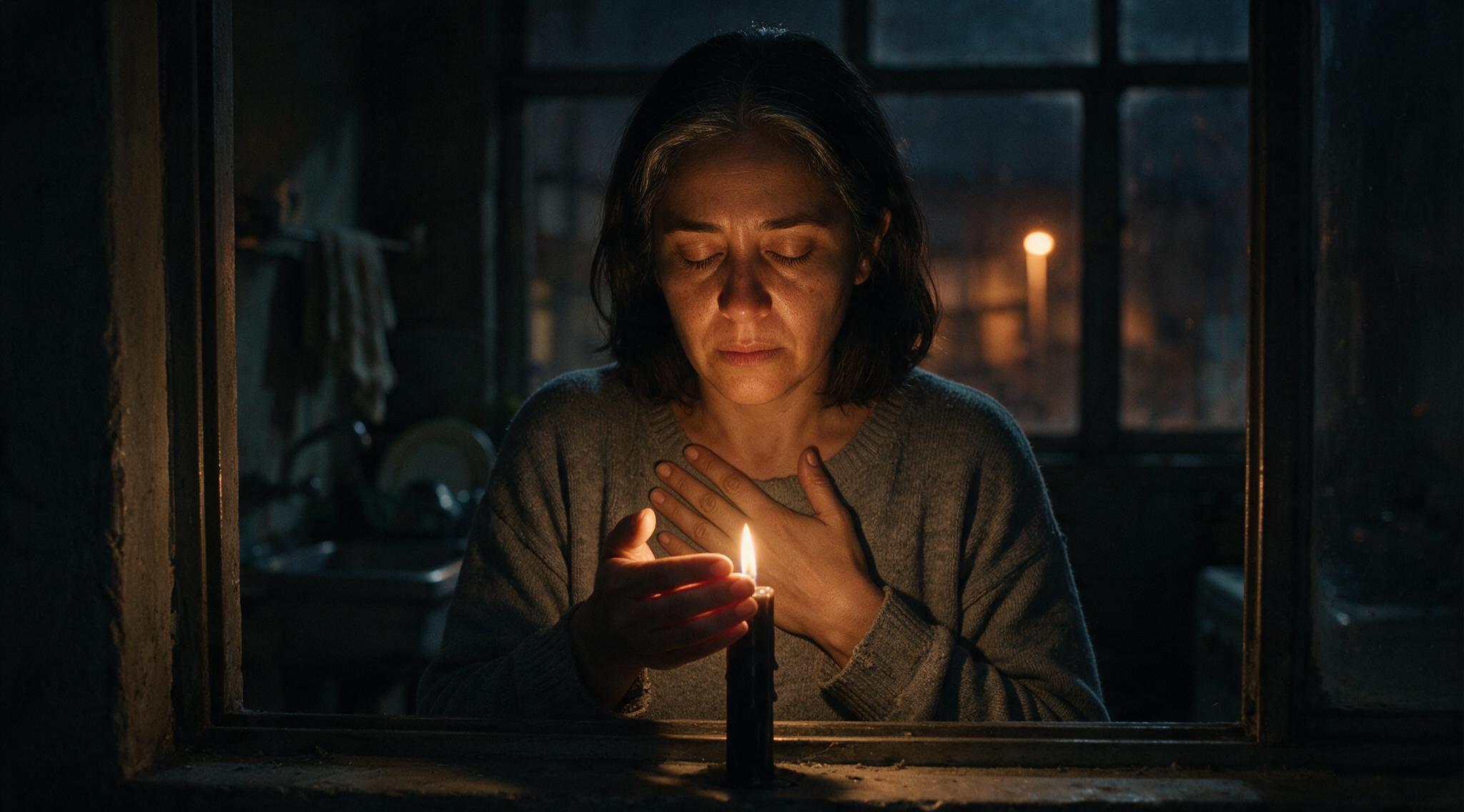
So when someone asks what black means, the better question is what black holds. In the attribute list devotees work from, the protection side is specific: protection against witchcraft, against assaults, against gun violence, against violent death. Roush put the word *desamparo* right in the title of her study of a Mexico City altar, protection and defenselessness in the same breath, and that pairing is the key to the black aspect.
The black robe is what you wear when you've been left without cover. A prison sentence does it. A debt does it. A neighborhood where the police arrive after does it. The petition that goes with black is rarely dramatic. Usually it comes down to: keep them off me, keep them off my kid, get him home.
Tepito, Prison Kinship, and the Social Life of the Shrine
The Cambridge study of the Mexico City cult found that Santa Muerte gained momentum among the fast-growing prison population over the last two decades, and it made a claim that flattens the usual stereotype: she connects families across the social abyss of imprisonment. Prisoners, prison officers, police, and their families all adopt her, as a capricious family member, and she embraces the same ambivalence as the forces they're trying to navigate.
Family member is the right word. In *National Geographic*, Alma Guillermoprieto profiles an inmate known as El Niño, Little Boy. He entered the prison 9 and a half years before the piece ran. His father abandoned him at 7, and his maternal grandparents raised him. He was 20 when he committed the murder that landed him there. He believes his protector kept jail wardens from finding a couple of forbidden objects on him. "The guards didn't see a thing, even though they were right there," he says.
His friend Antonio, in the same prison, charged with kidnapping, puts the rest of it plainly. She's there, he says, after all the friends you thought you had have forgotten your very name, and you're left, as the Mexican saying goes, without even a dog to bark at you. That's desamparo said out loud in a prison yard.
That kinship is the social life of the shrine, and it's what makes the first-of-the-month rosary more than a photo opportunity. Families come because the person they're praying for can't. They bring a black candle for the one inside. Then they go home and come back next month.
Stigma, Media, and the Ambiguities of Devotion
The Cambridge author's phrase for her is exact: not a one-dimensional sacred defender of criminals and police, but a capricious family member. Capricious matters. She isn't a vending machine, and the tradition doesn't promise she is. It also means the black aspect bothers people precisely because it refuses to sort its devotees into good guys and bad guys.
That refusal is where the ambiguity lives. Roush found the same iconography doing two jobs in Tepito at once: voices raised in indignation over being lumped together as violent, and voices using the same language to threaten. A neighborhood that gets read as criminal by the press develops a sharp tongue about it. Both registers are in the room at the monthly rosary.
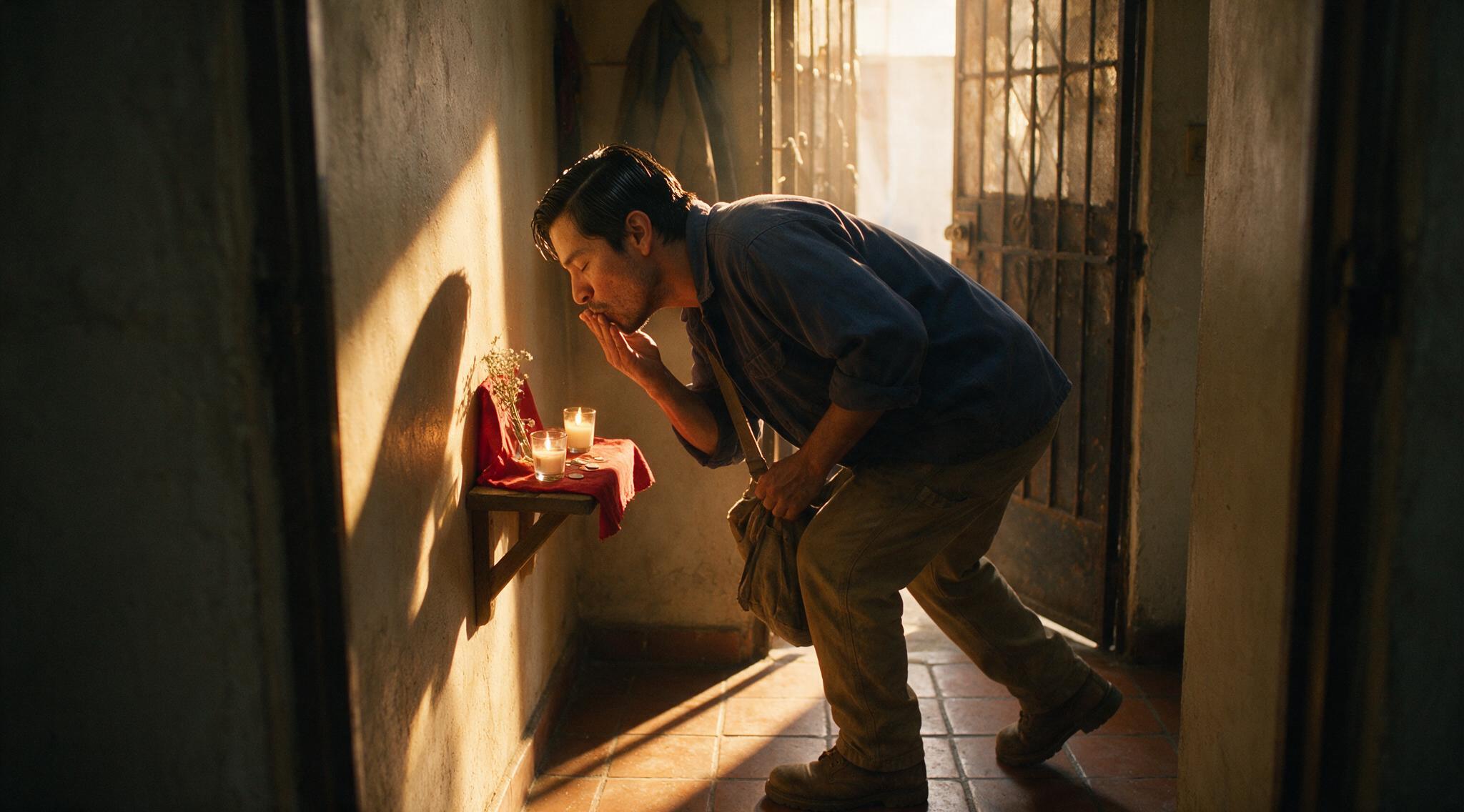
What the media usually skips is the dailiness. The statue gets dusted. The water gets changed. The candle gets lit when someone leaves for work. The petition is short. Devotees ask for love, money, protection, all three in the same breath, and they kiss the image on the way out the door. That ordinary practice is the actual cult, and it's much bigger than its worst week in the newspapers.
Limits
Nothing here replaces a doctor, a lawyer, a locked door, or a smoke alarm. If you or someone in your house is sick, see a clinician. If you're facing charges, talk to an attorney, not a candle. Lock your door, and don't let strangers into your home shrine, no matter how devoted they say they are. If you burn anything, burn it where you can watch it, on a stable surface, away from cloth and curtains, and put it out before you sleep or leave. Never promise another person's consent on their behalf. And no petition that names harm to someone else belongs on a Niña Blanca table. If a request needs a victim, it isn't a protection request.
Questions people actually ask
### Is the black robe only for protection?
Mostly, and that's how devotees use it. The protection cluster is where black sits: protection against witchcraft, assaults, gun violence, and violent death, along with safe passage. But her robe can be any color or pattern, and images vary widely from devotee to devotee, so nobody's going to check your papers over it.
### Do I need to be in Tepito to work with the black aspect?
No. The Alfarería street shrine is the public center, and the first-of-the-month rosary is its signature ritual, but a table at home is where most of this practice lives. Fresh water, a candle you can watch, and the name of the person you're praying for will do.
### Does black in Santa Muerte devotion mean curses?
Not in this house, and not in the sources. What the research documents is a range of gestures, from laments over being blamed to a language for making threats. The first is grief. The second isn't something you'll learn here.
### Why do so many devotees in Tepito have family in prison?
Because the prison population grew fast over the last two decades, and she's the saint who connects families across that separation. Prisoners, guards, police, and their families all keep her. That's an unusual mix, and it's the reason the devotion looks so strange to outsiders.
### Can I ask her for something for someone else?
Yes, and people do it constantly. Keep the request clean: safety, health, release, a job, a safe trip. Don't ask for anything that requires another person to be hurt, and don't decide for someone else what they should want.
You can start tonight without buying anything. Pour fresh water in a glass and set it on the table. If you have a black candle, light it where you can see it, say the name of the person you're worried about, and ask for cover rather than for harm. Then put it out before bed. When you're ready to go further, read Colors and Aspects for how the robes work in the tradition, and Altar Care for how to keep a small table clean, safe, and yours. That's the whole first step.